
Role : Main Designer / Lead UX Contributor
LYBRIX is a multimodal reading app designed to make reading feel more flexible, accessible, and sustainable. Instead of treating reading as a productivity task, the platform supports users who want to read, listen, pause, and return without pressure.
The experience combines digital reading, text-to-audio listening, and physical book exchange into one connected system. The goal is to reduce cognitive load and help users maintain a more realistic relationship with reading.
Reading platforms are built around progress tracking, rigid habits, or single-format content. For users with limited time, fluctuating focus, or visual strain, this can make reading feel stressful rather than supportive.
LYBRIX was designed to address three core problems:
The project was grounded in competitive analysis, empathy mapping, personas, user needs, focus group review, and user flow planning.
Research showed that users needed:
These findings shaped the structure of the app and helped define its core value: a reading platform that adapts to the user, rather than forcing the user to adapt to the platform.
The project was grounded in competitive analysis, empathy mapping, personas, user needs, focus group review, and user flow planning.
These findings shaped the structure of the app and helped define its core value: a reading platform that adapts to the user, rather than forcing the user to adapt to the platform.
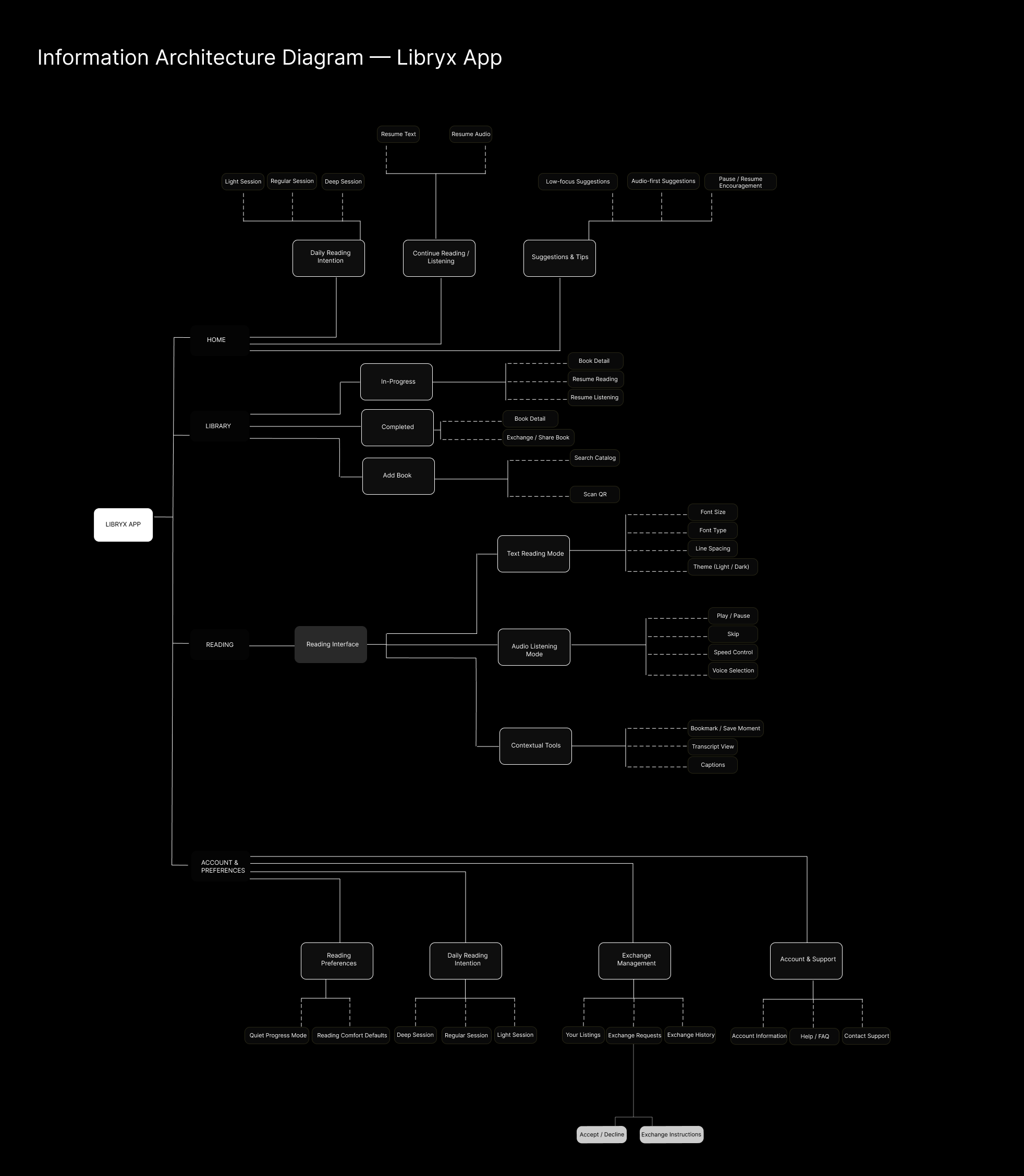
The information architecture defines LYBRIX as a multi-part ecosystem rather than a simple reading app. The IA diagram shows the platform structured across four main areas: Home, Library, Reading, and Account & Preferences. Within those areas, the system includes daily reading intention, in-progress and completed reading, book detail pages, audio listening mode, text reading mode, contextual tools, exchange management, reading preferences, and support flows.
This IA reflects one of the most important design directions of the project: reading is not framed as a linear task, but as an adaptable experience that can shift based on user focus, context, and accessibility needs.
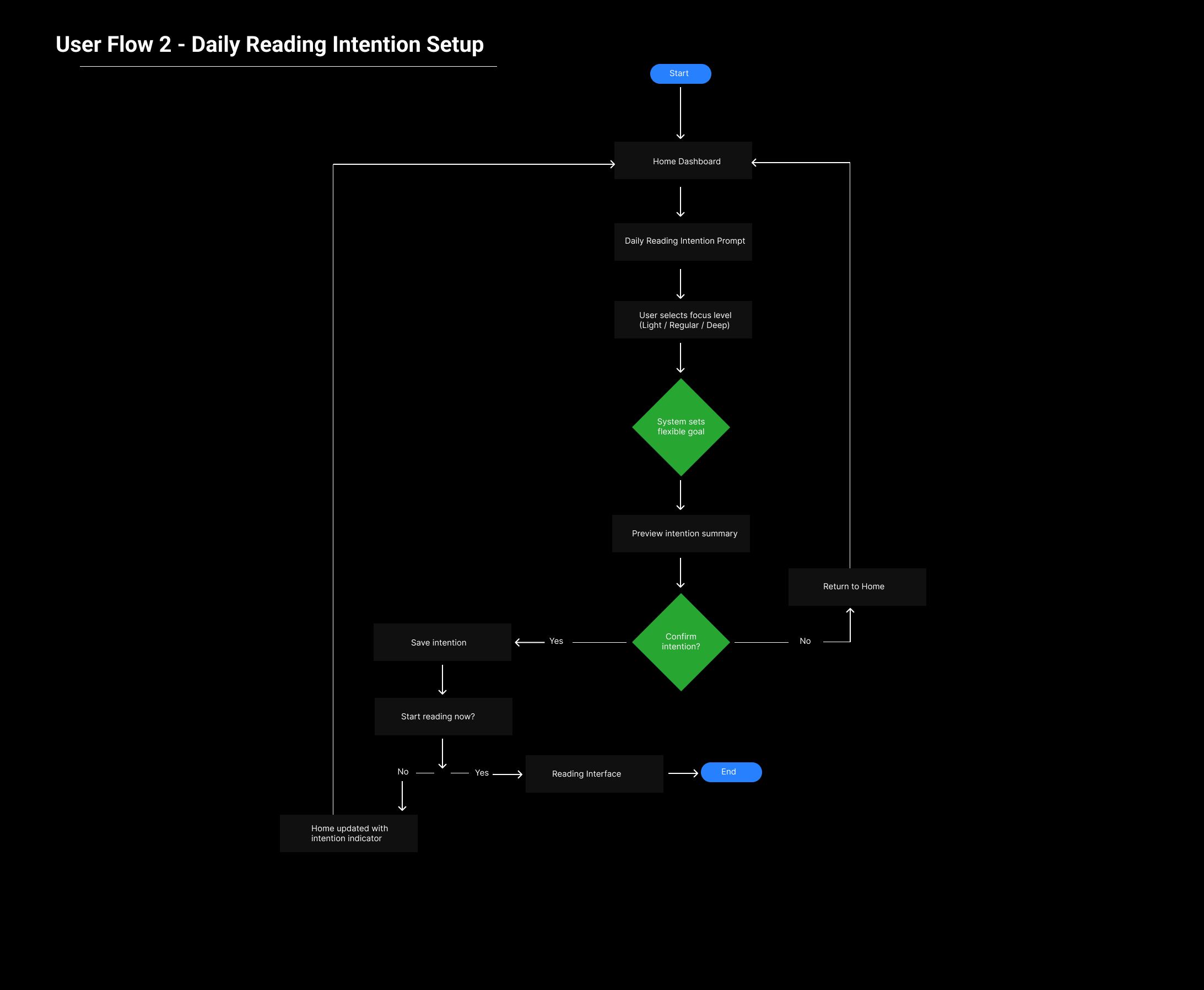
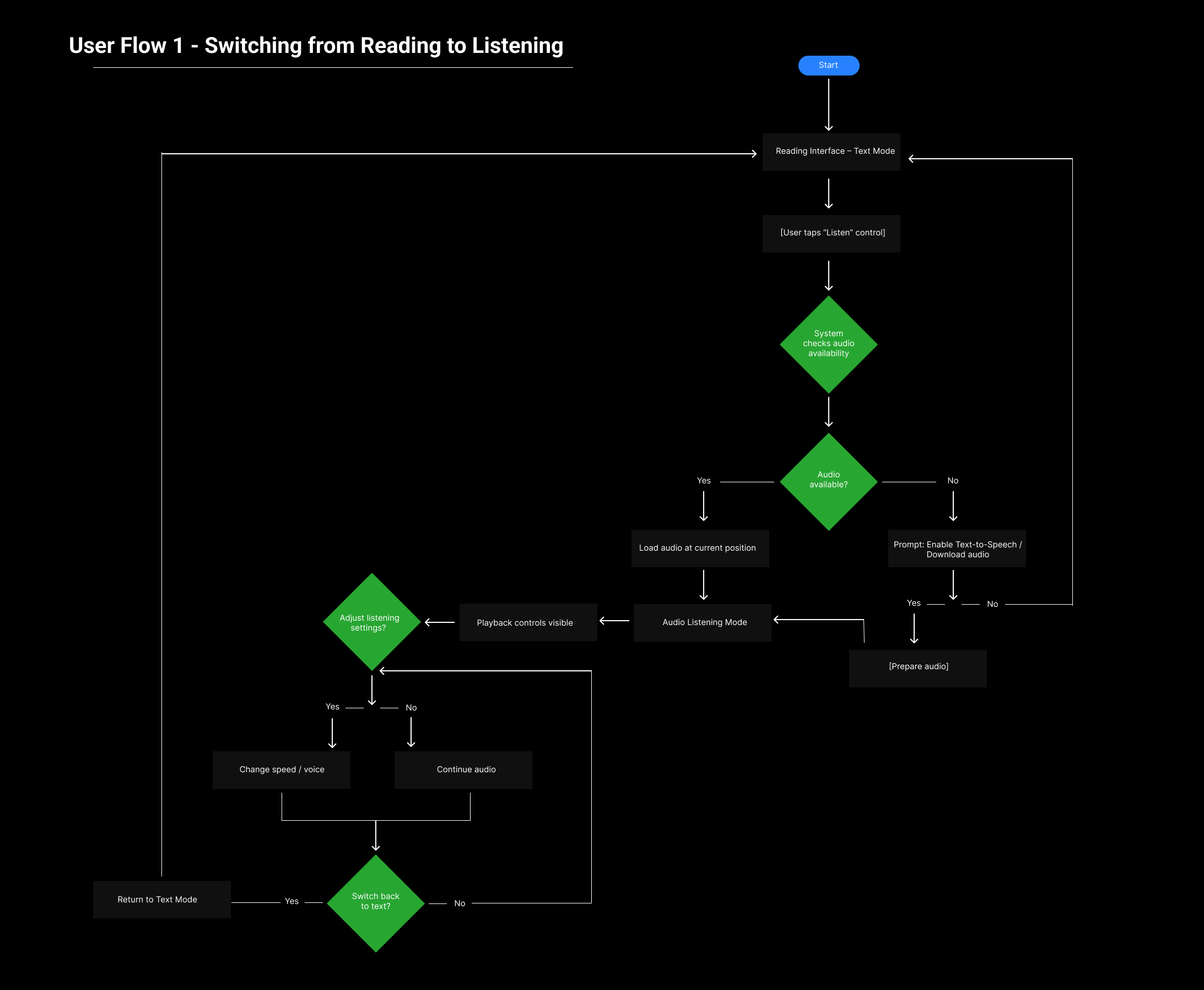
Developed key user flows to define how users move through the app and switch between major interaction modes.
The two most important flows focused on:
These flows helped establish the logic of the app and ensured that the experience aligned with the project’s core goal of flexible, pressure-free reading.
This is a portfolio case study rather than a complete design archive, I am intentionally showcasing only selected low-fidelity wireframes that best represent the app’s core UX structure. The complete low-fidelity system covers the broader app, but for case study clarity I am only presenting the most strategically important screens
.png)
%20(1).png)
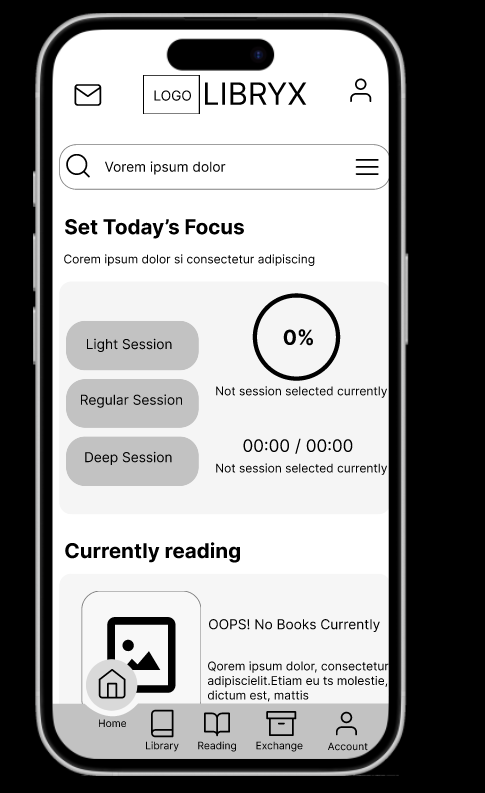
The Home experience is designed to reduce friction at the point of entry by guiding users quickly into a relevant reading state. Instead of overwhelming users with content or productivity-driven elements, the interface prioritizes clarity, continuity, and low-pressure engagement.
Key elements include daily reading intention, in-progress access, and contextual recommendations that support resuming rather than restarting. This approach aligns with the overall information architecture and user needs focused on flexibility and cognitive ease.
As the lead designer, I was responsible for designing this part of the experience. The low-fidelity wireframes were developed as part of a broader system based on the IA and user flows. For this case study, only the most relevant screens are showcased to highlight my contribution to the core experience.
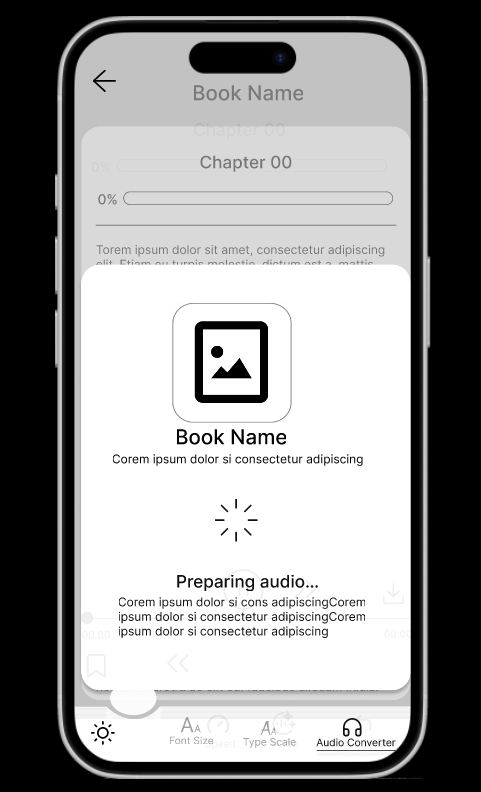
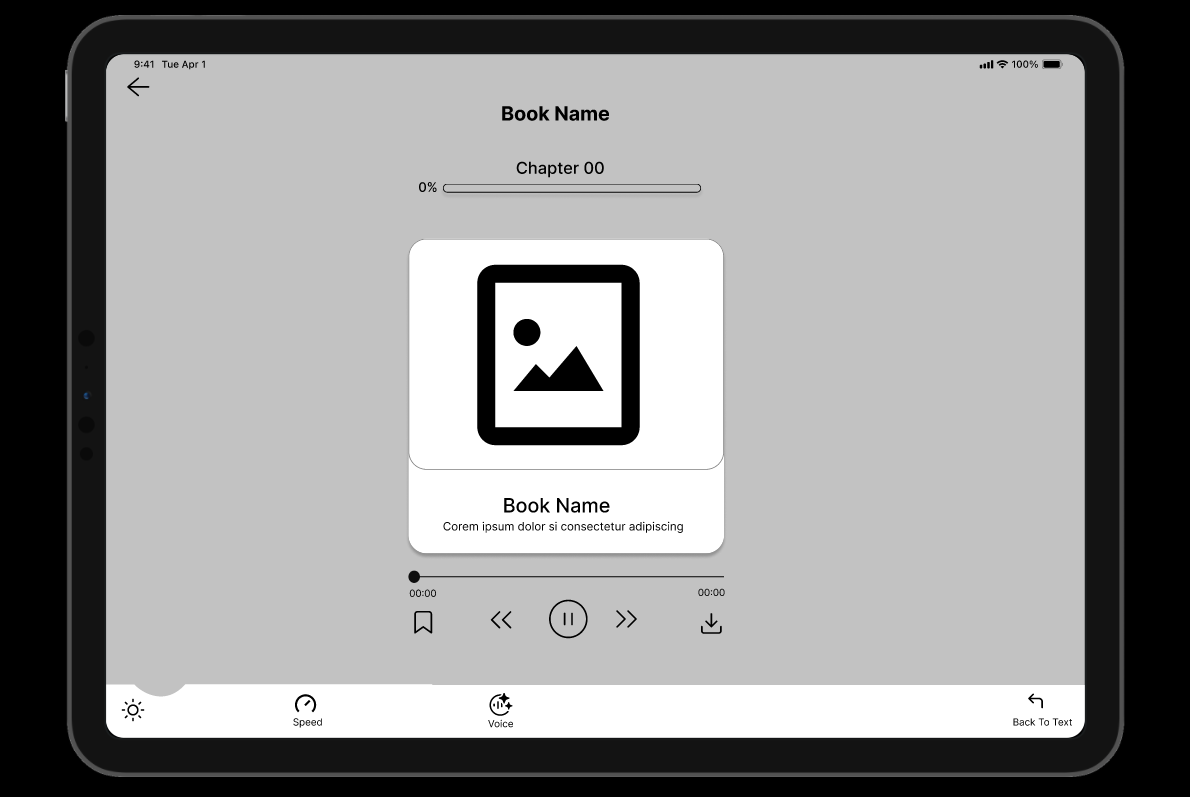
The Reading Interface represents the core interaction environment of LYBRIX. It is designed as an adaptive system that supports both text and audio modes, along with contextual tools such as bookmarking, playback controls, transcripts, and adjustable settings.
Rather than a static reading page, this experience enables seamless transitions between formats, supporting users with different cognitive states, accessibility needs, and reading preferences. This directly responds to key user needs identified in research, particularly around flexibility and continuity.
As the lead designer, I contributed specifically to this experience by developing its structure through low-fidelity wireframes based on the IA and defined user flows. While a full set of wireframes was created for the app, only selected screens are presented here to clearly showcase my contribution to the core interaction logic.
The project has progressed into early-stage prototype validation using a low-fidelity interactive model. At this stage, the prototype is not fully developed, but is intentionally simplified to test core structure, navigation, and task clarity.
Maze testing was used to evaluate how users move through key flows, including entry from the Home experience and interaction within the reading interface. Because the prototype is based on low-fidelity wireframes, the focus is on usability and comprehension rather than visual design.
This approach allows early validation of structural decisions before advancing to higher-fidelity design.

Although LYBRIX is a team project, I contributed as the main designer and lead UX contributor, with primary responsibility for defining the structural foundation of the experience.
My role included developing the information architecture, creating key user flows, and shaping selected low-fidelity wireframes used for early validation. I also contributed to research synthesis and supported focus group analysis to translate insights into design decisions.
This role required maintaining alignment between research, structure, and interaction design, ensuring that the product consistently reflected its core goal of a low-pressure, adaptable reading experience.
The project is currently in an ongoing development phase, with research, IA, user flows, and selected low-fidelity wireframes completed, along with initial prototype testing.
Next steps include refining the tested flows, improving clarity based on user feedback, and advancing the prototype toward higher-fidelity design.
This is your chance to make a significant change in your life.




.png)

